Colors are not expressed or defined in the same language. First, think about the difference between Fushia, Violet, Magenta, Red, and Turquoise, or all the variations of white. Then think of all the languages around the world. That is the same for colors in the printing Industry.
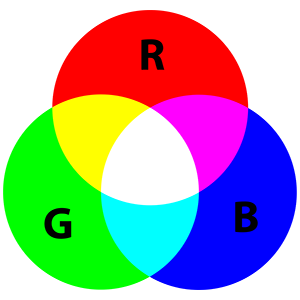
RGB (additive color model)
 |
| Source: Wikipedia |
Screens speak the RGB language. Red, green, and blue components come from light combinations of excitation. Take two screens (even the same brand and model) and you will have slightly different colors with the same RGB values. Because even the same quantities of excitation do not provoke exactly the same reaction.
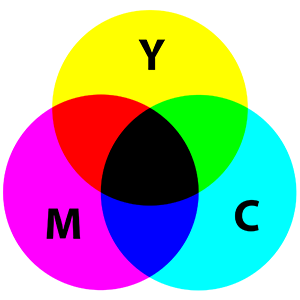
CMYK (subtractive color model)
 |
| Source: Wikipedia |
Printers speak the CMYK (Cyan, Magenta, Yellow, Black) language. Or CMYKcm (with light cyan and magenta). Or CMYLOG (with Orange and Green). Or whatever mix of colored inks. Throw the same quantities of inks from different bottles on the same media, and there are chances that you will get slightly different colors. It is worse when you add some instabilities like moving heads, different speeds, blocked nozzles, etc.
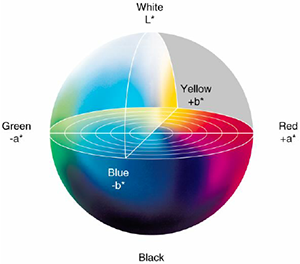
CIE L*a*b*
 |
| Source: Researchgate |
It is possible to measure color waves, also known as "Spectrums", with a spectrophotometer device (refer to our dedicated HelpDesk section to learn more about them). The measure looks like a curve with values and a subset of wavelengths, however, what we see during color measure is not color itself, it is physical data.
Scientists built a science around that and defined a variety of independent color spaces based on some empiric references (a standard observer, a standard light, and some standard conditions of viewing). This meant that the same color values equal the same measured wave, so hopefully the same perception for an ordinary observer under normal light and some standard conditions.
The color specialists also defined a color space called Lab (the correct name is CIE L*a*b*, but let's use Lab instead), and the industry began to use it as a conveniently shared language between all other colorspaces (like the Esperanto language, for example).
You can find in various software other independent colorspaces like CIE XYZ, CIE Luv, etc. They were all defined in the CIE (Commission Internationale de l'éclairage or International Commission on Illumination) and are cross-compatible if you know the math behind them.
What is the Delta E value?
Another important element in color science is the difference or distance between one color and another (within the color space). In this regard, a metric is used to quantify this distance with an exact value (something that previously could only be described in words).
The CIE calls their distance metric ΔE* (also known as dE*, dE, or simply Delta E), where delta stands for the greek letter often used to denote difference, and E stands for "Empfindung" (german for "sensation")". In simpler words, from Colormine.org:
Delta-E is a single number representing the "distance" between two colors.
It's tempting to simply compare the Euclidean distance difference between the red, green, and blue aspects of an RGB. Unfortunately for us, RGB was intended for convenient use with electronic systems, however, it doesn't align with how we actually perceive color. Testing this method quickly reveals sporadic and often drastically different results than one would expect of visually "similar" colors.
| Delta E | Perception |
| <= 1.0 | Not perceptible by human eyes |
| 1 - 2 | Perceptible through close observation |
| 2 - 10 | Perceptible at a glance |
| 11 - 49 | Colors are more similar than opposites |
| 100 | Colors are the exact opposite |
Why dE00 is better than dE76?
Over the years, scientists have come up with many ways to calculate the perceived difference in color. For many years, the most popular method was the CIE 1976 (also known as CIE76 or dE76). This method uses the Euclidean distance while converting it to the CIE*Lab color space.
In 1984 and 1994 there were major revisions to the CIE76, but it was not until 2000 that the most accurate contribution was made:
Delta-E 2000 is the first major revision of the dE94 equation. Unlike dE94, which assumes that L* correctly reflects the perceived differences in lightness, dE2000 varies the weighting of L* depending on where in the lightness range the color falls (Source: ColorWiki).
It’s currently the most complicated, yet most accurate, CIE color difference algorithm available (Source: Zachary Schuessler)